S2-OMC
Control Room Monitor Channel
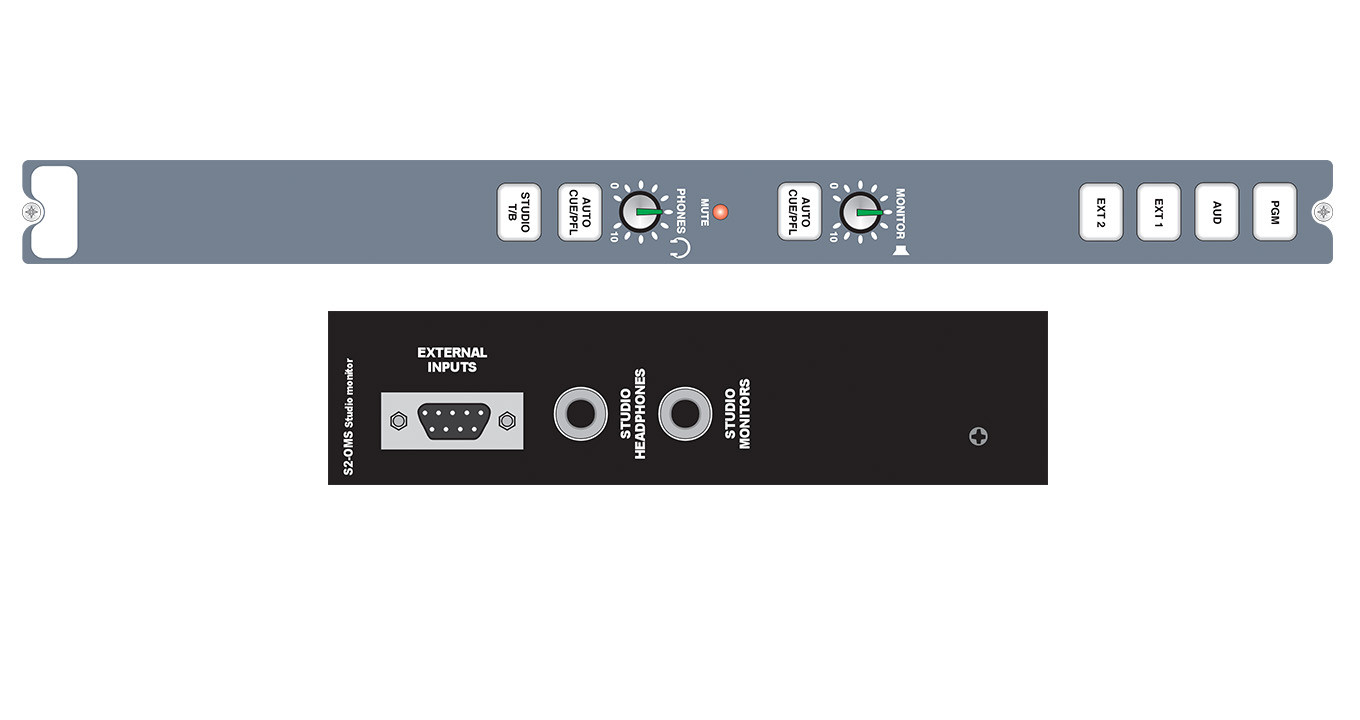
The control room monitor channel is common to every mixer and is used for monitoring various sources on the control room loudspeakers or on headphones.
S2-OMC
Control Room Monitor Channel
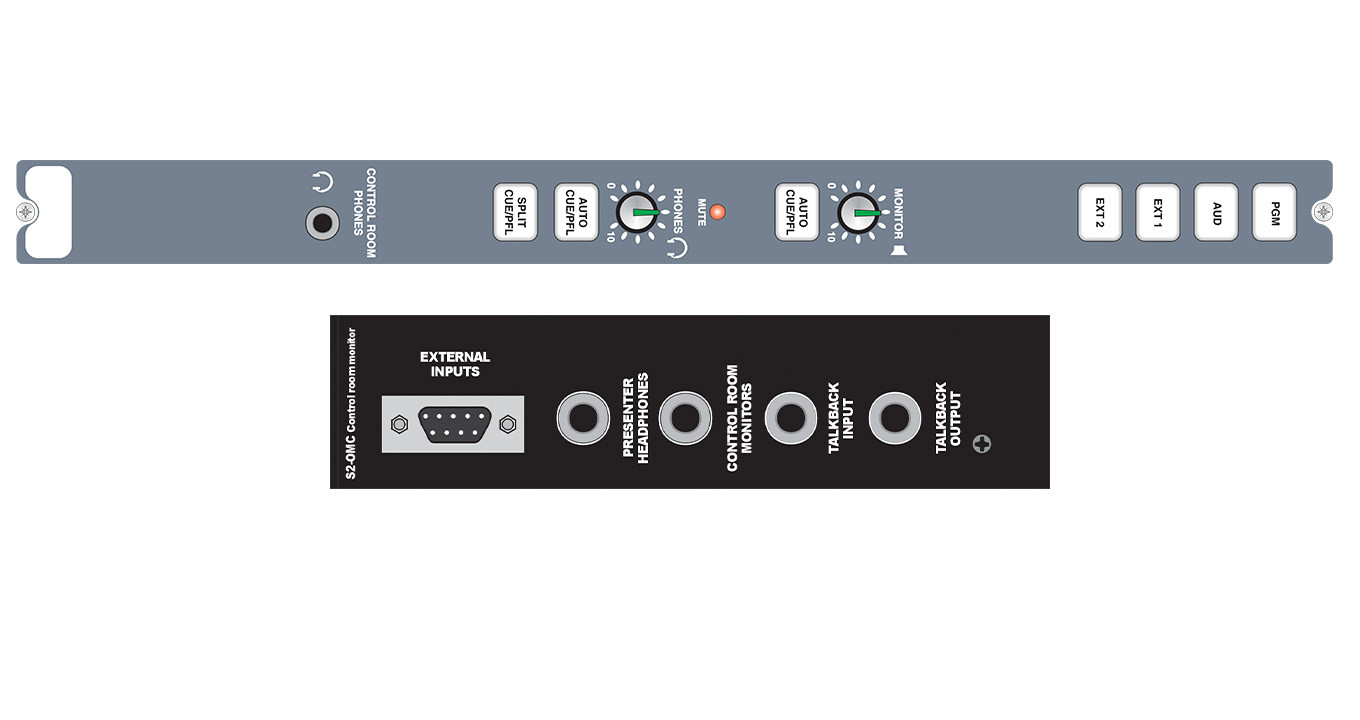
The control room monitor channel is common to every mixer and is used for the monitoring of various sources on the control room loudspeakers (MONITOR) on a 6.35mm stereo jack socket and presenter’s headphones (PHONES) on 6.35mm stereo jack sockets. Front panel control knobs are used to vary the monitor and headphone levels and headphones can be plugged in at the front or the rear of this channel. The control room monitor loudspeaker and headphone levels are variable between 0 (cut off) and 10 (max).
A four way electronically interlocking switch bank selects the source routed to the speakers and headphones from either of two external inputs (EXT 1, EXT 2), the PGM, or AUD output. The buttons illuminate to show the selected source: PGM and AUD are green, EXT 1 and EXT 2 are red. The external inputs can be used for monitoring an off air signal or another studio output.
An illuminated Mute LED shows when a live microphone channel in the control room has muted the speakers, to prevent feedback. Mute outputs on the remote connector of the PGM output channel can be used to remotely illuminate “Mic Live” lights.
AUTO CUE/PFL buttons adjacent to each level control allow the monitoring of PFL when an input channel has been selected to CUE/PFL. In addition, SPLIT CUE/PFL can be selected to the headphones, which will place the selected source in mono in one ear and PFL in mono in the other.
This channel controls the signal conditioning for the talkback input and output and routes these signals to and from the talkback bus. Internal jumpers can be configured to allow talkback to replace or dim the selected source, dimming independently on monitor speakers or headphones.
A Global Talkback system can be configured to allow every contribution point in the control room and studio to communicate with each other via their microphone and headphones.
Product Features
Selectable PGM, AUD, EXT 1 and EXT 2 Sources.
Source selection indicator lights.
MONITOR and PHONES outputs.
PHONES available on front and rear panels.
MUTE LED indicator.
MUTE remote outputs for 'Mic Live' lights.
AUTO CUE / PFL buttons for each output.
SPLIT CUE / PFL button for headphones.
Talkback input and output routing.
Typical Applications
Product Category
Mix ConsolesTECHNICAL SPECIFICATIONS
Input/Output Impedances | |
|---|---|
| Mic Input: | > 1k5Ω electronically balanced |
| Mono Line Input: | > 20kΩ electronically balanced |
| Stereo Line Input: | > 20kΩ electronically balanced |
| PGM & AUD Output: | < 75Ω electronically balanced |
| Mono Output: | < 75Ω electronically balanced |
| Monitor Outputs: | < 75Ω unbalanced |
| AES Input/Output: | 110Ω |
| S/PDIF Input/Output: | 75Ω |
| BNC Wordclock input: | 50Ω |
Input/Output Gain Range | |
| Mic Input: | Preset pot +13dB to +66dB ref -50dBu, TRIM pot ±12dB |
| Mono Line Input: | Preset pot -6dB to +10dB ref 0dBu, TRIM pot ±12dB |
| Stereo Line Input: | Preset pot -6dB to +10dB ref 0dBu, TRIM pot ±12dB |
| Telco Input: | Preset pot -6dB to +10dB ref 0dBu, TRIM pot ±12dB |
| Telco Output: | Preset pot -6dB to +4dB ref 0dBu |
| Mix Minus Input: | Preset pot -6dB to +10dB ref 0dBu, TRIM pot ±12dB |
| Mix Minus Output: | Preset pot -3dB to +3dB ref 0dBu |
| Digital Input: | 0dBFS = +12dBu on input; TRIM pot ±12dB allowing 0dBu to +24dBu |
| Digital Output: | 0dBFS = +18dBu |
Frequency Response | |
| Mic Input: | 40Hz to 20kHz, -1dB,+0dB (-3dB at 130Hz with HPF in) |
| Line Inputs: | 20Hz to 20kHz, - 0.5dB,+0dB |
| RIAA Input: | 30Hz to 16kHz ±1.5dB RIAA equalised |
Noise (20Hz to 20kHz) | |
| Mic Input E.I.N.: | -129dB with 150Ω source |
| Stereo Inputs (fader down, no routing): | -89dB ref 0dB |
| Stereo Inputs (fader down, one channel routed): | -89dB |
| Stereo Inputs (unity gain, no routing): | -89dB |
| Stereo Inputs (unity gain, one channel routed): | -86dB |
| Stereo Inputs (unity gain, two channels routed): | -83dB |
Distortion | |
| Total Harmonic Distortion: | 0.015% at 1kHz, 0dB |
| Total Harmonic Distortion: | 0.025% at 10kHz, 0dB |
Crosstalk | |
| Inter-channel: | < -90dBu |
| Stereo: | -90dBu at 1kHz |
Equalisation | |
| LF Shelving at 100Hz: | ±7dB |
| HF Shelving at 6.5kHz: | ±7dB |
Range | |
| Pan Range: | off/-3dB centre/off |
| Balance Range: | ±6dB |
Common Mode Rejection Ratio | |
| Mic Input: | > 100dB at 70dB gain |
Digital I/O | |
| Sync Input Sample Rate: | 30kHz - 100kHz |
| Output Sample Rates (Using Onboard Clock): | 32kHz, 44.1kHz, 48kHz, & 96kHz |
| Output Sample Width: | 16, 20, 24 bit (24 bit on V2 ODA/ODP) |
Output | |
| Headphone Output Load: | >45Ω, 400Ω recommended |
| Maximum Output (Analogue): | +26dBu balanced into 2kΩ or greater |
Power | |
| Power (S2-PSU): | Filtered IEC, switchable 115V, 230V, fused, 210W max. |
| Dimensions (S2-PSU): | 48cm (W) x 24.3cm (D) x 8.8cm (H) |
| (Raw): | 19” (W) x 10” (D) x 3.5” (H) |
| Dimensions (S2-PSU): | 51cm (W) x 41.5cm (D) x 17cm (H) |
| (Boxed): | 20” (W) x 16.3” (D) x 6.7” (H) |
| Weight (S2-PSU): | Nett: 6kg Gross: 7.8kg |
| Weight (S2-PSU): | Nett: 13.2lbs Gross: 17lbs |
| Dimensions (S2-PSUS): | 48cm (W) x 23cm (D) x 4.4cm (H) |
| (Raw): | 19” (W) x 9” (D) x 1.7” (H) |
| Dimensions (S2-PSUS): | 55cm (W) x 39.3cm (D) x 8.5cm (H) |
| (Boxed): | 21.6” (W) x 15.5” (D) x 3.4” (H) |
| Weight (S2-PSUS): | Nett: 1.58kg Gross: 2kg |
| Weight (S2-PSUS): | Nett: 3.5lbs Gross: 4.4lbs |
SUPPORT
| S2-OMC Handbook | [Download] |
Brochures
| Click to visit the brochures page. |
Declarations
| Click to visit the declarations page. |
| S2 Laser Label Templates to create your own descriptive labels using Adobe Illustrator or other graphic packages. | Version | Date | [Download] |